At least 23 well known authors were ambulance drivers during World War I, including Ernest Hemingway, John Dos Passos, E.E. Cummings, and Somerset Maugham. Robert Service, the writer of Yukon poetry including The Shooting of Dan McGrew, and Charles Nordhoff, co-author ofMutiny On the Bounty, also drove ambulances in the Great War. Read the full and fascinating story HERE on firstworldwar.com
He was the only general of the major powers to find a solution to the stalemate of trench warfare. Using stealth, surprise, and overwhelming force on a narrow front with well-planned breakthrough operations, he managed to penetrate and destroy the Austro-Hungarian army lines between Kovel and Lutsk. The effect of his penetration, which had the possibility of shattering the AH lines was lost when the commanders on each side of his penetration, scorning his innovations, launched conventional attacks in support. When these bogged down, the Russian high command took units from Brusilov’s successful front and transferred them to the unsuccessful fronts, throwing away a major opportunity to change the outcome of the war in the east.
Brusilov’s ideas included:
doing away with long preliminary artillery bombardments across the front (which notified the enemy that an offensive was coming, and where it would be launched), with short bombardments aimed at communications and transportation resources (which were vulnerable) instead of first-line fortifications (which usually were not)
Attacking multiple specific points at the same time, rather than a continuous attack all along the front.
The leading troops of each attack were called “shock troops” and were carefully briefed about what they should expect when they reached their objective and what they should do.
The troops of the offensive were not brought to the front line until the last moment before the bombardment began, so the enemy would not have time to mass troops for resistance.
Brusilov’s tactics were no less expensive of men than the tactics used by other generals. He lost many; but he was successful in piercing the fortified line.
Unfortunately, he was a general in an army riddled by corruption, favoritism, and resistance to change. He lacked the political pull with the Imperial Court his contemporaries had. Until it was too late, the habit of taking forces from successful operations to reinforce failing ones continued. AH, which suffered from the same problems, might have been completely destroyed beyond the power of Germany to rescue them without fatally weakening themselves in the west had Brusilov been given control after his immediate success.
But the Germans learned much from him. It is they who benefited from his innovations. Their use of shock troops almost lead them to victory in the Ludendorf offensives that led to the Second Battle of the Marne.
Brusilov’s tactics of using carefully-trained shock troops to hit vital areas and using artillery to hit supply and communications rather than built-up fortifications, when combined with the use of tanks as spearheads for the attacks, and pinpoint air support for the attacks using dive bombers were combined in the tactics that came to be known asBlitzkrieg. It is ironic that two of the main constituents of Blitzkrieg were conceived of or developed by Allied leaders, specifically General Brusilov, and Winston Churchill.
He was the only general of the major powers to find a solution to the stalemate of trench warfare. Using stealth, surprise, and overwhelming force on a narrow front with well-planned breakthrough operations, he managed to penetrate and destroy the Austro-Hungarian army lines between Kovel and Lutsk. The effect of his penetration, which had the possibility of shattering the AH lines was lost when the commanders on each side of his penetration, scorning his innovations, launched conventional attacks in support. When these bogged down, the Russian high command took units from Brusilov’s successful front and transferred them to the unsuccessful fronts, throwing away a major opportunity to change the outcome of the war in the east.
Brusilov’s ideas included:
doing away with long preliminary artillery bombardments across the front (which notified the enemy that an offensive was coming, and where it would be launched), with short bombardments aimed at communications and transportation resources (which were vulnerable) instead of first-line fortifications (which usually were not)
Attacking multiple specific points at the same time, rather than a continuous attack all along the front.
The leading troops of each attack were called “shock troops” and were carefully briefed about what they should expect when they reached their objective and what they should do.
The troops of the offensive were not brought to the front line until the last moment before the bombardment began, so the enemy would not have time to mass troops for resistance.
Brusilov’s tactics were no less expensive of men than the tactics used by other generals. He lost many; but he was successful in piercing the fortified line.
Unfortunately, he was a general in an army riddled by corruption, favoritism, and resistance to change. He lacked the political pull with the Imperial Court his contemporaries had. Until it was too late, the habit of taking forces from successful operations to reinforce failing ones continued. AH, which suffered from the same problems, might have been completely destroyed beyond the power of Germany to rescue them without fatally weakening themselves in the west had Brusilov been given control after his immediate success.
But the Germans learned much from him. It is they who benefited from his innovations. Their use of shock troops almost lead them to victory in the Ludendorf offensives that led to the Second Battle of the Marne.
Brusilov’s tactics of using carefully-trained shock troops to hit vital areas and using artillery to hit supply and communications rather than built-up fortifications, when combined with the use of tanks as spearheads for the attacks, and pinpoint air support for the attacks using dive bombers were combined in the tactics that came to be known asBlitzkrieg. It is ironic that two of the main constituents of Blitzkrieg were conceived of or developed by Allied leaders, specifically General Brusilov, and Winston Churchill.
Food in the trenches was awful. It was OK for the first year or so but after a while it was terrible. Even on the Allied side it was bad. Soldiers complained about the stale bread, corned beef(which sometimes was moldy) and the watered down milk and rum. Americans complained bitterly of their tasteless 'goldfish stew', which was fish stew, and their meat was often soggy. British soldiers got so sick of plum and apple jam that 13 divisions(that's 130,000 troops) wrote a petition, demanding that they get a different flavor.
On the German side it was much, much worse. Allied food was bad but it was at least 'real food', as in it was what it claimed to be. As the blockade of German ports dragged on the Germans had to resort to eating 'substitutes'. These include coffee made of acorns and coal, banana made of turnip and sugar, meat that progressed from dog and cat, to rat, to mashed worms, and much more. Winter 1917 was called "The Turnip Winter" since turnips were the only thing that was plentiful, with carrots being a close second.Food in the trenches was awful. It was ok for the first year or so but after a while it was terrible. Even on the Allied side it was bad. Soldiers complained about the stale bread, corned beef(which sometimes was moldy) and the watered down milk and rum. Americans complained bitterly of their tasteless 'goldfish stew', which was fish stew, and their meat was often soggy. British soldiers got so sick of plum and apple jam that 13 divisions(that's 130,000 troops) wrote a petition, demanding that they get a different flavor.
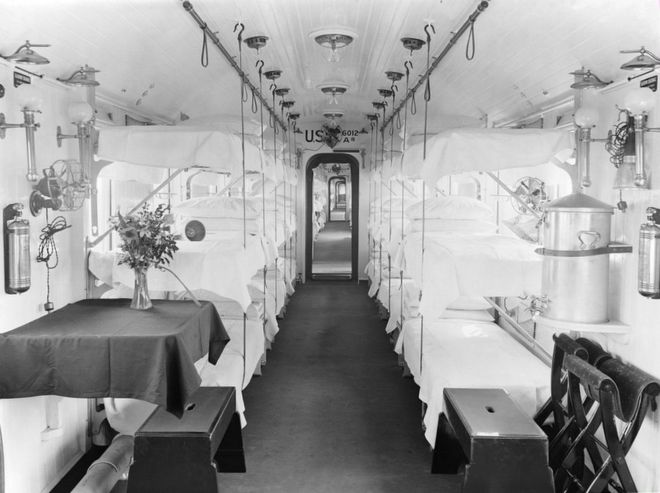
Thanks to Jeff Long for alerting me to this -- Ambulance trains were mostly filled with bunk beds for injured soldiers
An exhibition on World War One ambulance trains which whisked soldiers away from battlefields has opened.
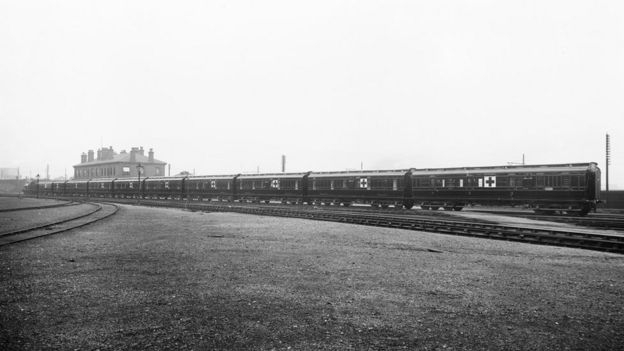
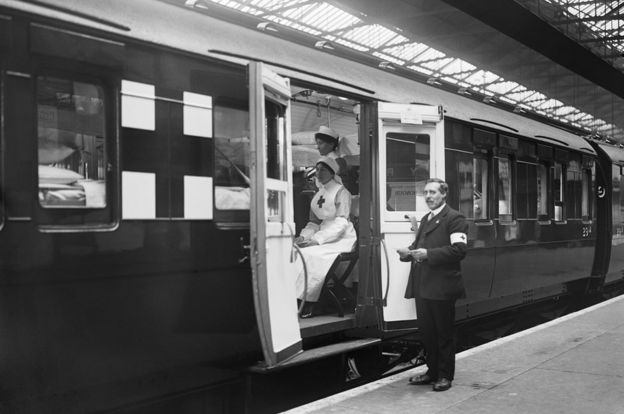
The purpose-built trains bearing a red cross carried 2.7m passengers in the United Kingdom during the conflict.
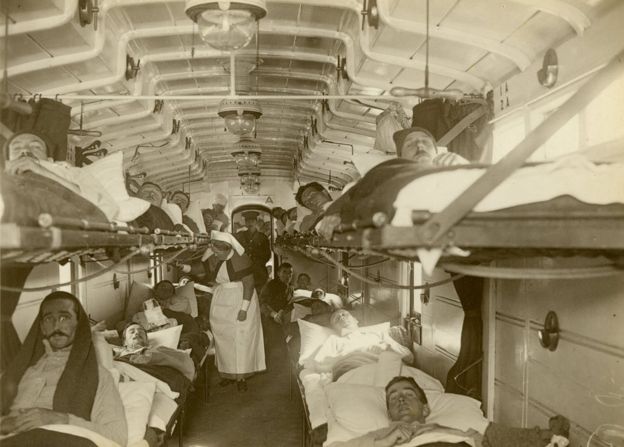
Some carriages were filled with rows of bunk beds to hold recovering soldiers, while others served as treatment rooms.
The opening of the exhibition at the National Railway Museum in York marks 100 years since the busiest day of ambulance train traffic during the war.
Image copyrightWILLIS FAMILY COLLECTIONImage captionGeorge Owen Willis, an orderly on ambulance train number 18, served for the entire duration of the conflict and documented his experiences with photographs
The trains also carried people in the Western Front, the Mediterranean and Egypt, with medical staff living on-board.
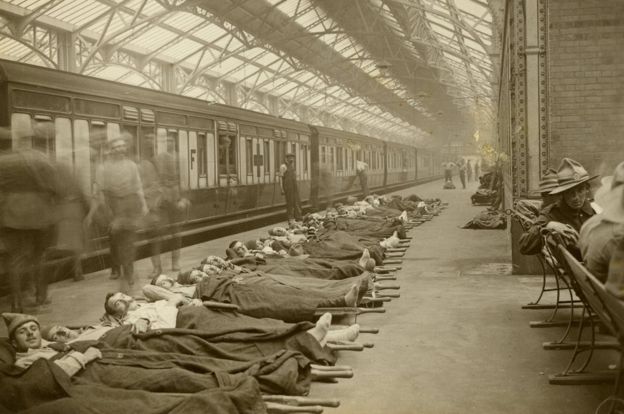
Rest rooms were established at railway stations across the UK to deal with wounded troops coming back from the front lines.
Image copyrightWILLIS FAMILY COLLECTIONImage captionThe trains carried injured soldiers away from the battlefields
Several of the most renowned poets of the war, including Siegfried Sassoon and Wilfred Owen, travelled on ambulance trains.
Image copyrightNRM
Excerpt from Good-Bye to All That, an autobiography by Robert Graves
"That evening, the R.A.M.C. orderlies dared not lift me from the stretcher to a hospital train bunk, for fear of it starting haemorrhage in the lung.
So they laid the stretcher above it, with the handles resting on the head-rail and foot-rail.
I had now been on the same stretcher for five days. I remember the journey as a nightmare."
Despite carrying a red cross, some trains were still shelled and hid in tunnels for protection.
Image copyrightWILLIS FAMILY COLLECTIONImage captionPictured is ambulance train number 7 being loaded with injured soldiersImage copyrightNRMImage captionMedical staff lived on the trains, some for the entirety of the warImage copyrightNRMImage captionAmbulance trains often had an extra coach carrying non-injured military personnelImage copyrightNRMImage captionA carriage of an ambulance train is pictured being hoisted in Blackpool in February 1916Image copyrightHORWICH WORKSImage captionThe pharmacy carriages were stocked with medicines to help the injured
Andrew Baker, I've used them, I don't mind them, I wouldn't mind owning one. Or two. Or ten.
10k Views
Because the machine guns they had then were enough of a mature technology to be able to fire for hours on end.
This is a Vickers machine gun. Notice the giant barrel. That's not actually a barrel, that is the water-filled cover for one. The water is poured into the shroud and the water boils, then condenses inside the hose attached to it, and drains into a can. Your pour the can right back into the gun and continue firing.
Anyway, once infantry go "over the top" and charge at the enemy, the artillery will fire and take out many, many men. The the machine guns begin to cut swaths of men down, the ones who got through the artillery. Nobody will live long enough to actually hold any ground because of the amount of firepower the machine guns can bring to bear. When people call them "bullet hoses", it has a literal meaning. These things could fire until a jam happened, the ammo ran out, or the enemy ran out of men to throw at it.
Edit 1, Raghupathy Srinivasan added that the machine guns were also combined with barbed wire to make a death trap for advancing infantry. Don't believe us? Check this out below!
Edit 2, Tim van der Wal pointed out that this is a diagram of tank obstacles followed by barbed wire, probably of a Finnish defensive line. The principle is the exact same, however :)
The schematic is admittedly crude, and I actually did not create it. But you can see how the wire is not laid out in straight lines. This way, you create interlocking fields of fire for each machine gun. If you have enough time, you can also zero in friendly artillery or mortars to fire in the event that the enemy starts to attack through the wire.
World War One soldiers were not stupid, trench warfare was complicated and a matter of military science and tactics that have constantly evolved. This kind of stuff is still used today. From the Bar Lev Line...
To Dien Bien Phu...
Trenches will never be outdated, especially against foes without significant artillery or air power.
The park-like memorial, which features sculptures that the proposal says “stress the glorification of humanity and enduring spirit over the glorification of war,” won't be on the National Mall. (New construction on the Mall is prohibited by law.) Rather, it will be located in Pershing Park near the White House—a park that already houses a smaller scale World War I memorial.
Atlas Obscura has an overview (pun intended) on aerial Reconnaissance Photos of WWI Battlefields:
Aerial photography was a relatively new technique at the outset of World War I. Over the next four years, it became an invaluable reconnaissance tool. Cameras were developed for aerial use, but the process was still not easy. To note enemy positions accurately, clues in the resulting images, like shadows and soil displacement, had to be interpreted as well.
As the book The Great War Seen From the Air recounts: “They took photographs from an open cockpit. The exposure had to be set manually and after every shot the glass negative had to be replaced and stored away. Meanwhile, the observer photographer combed the skies for enemy planes looking for observation planes to shoot down.”
This is a brief glimpse at the charitable work of the first Jewish-Canadian to be made an officer of the Order of the British Empire for her work with World War One veterans. It was written by Lynn Capuano, Army Public Affairs for the Canadian Army.
Lillian Freiman’s modus operandi was “do good by stealth.” As a result of her humility, her many great works for the good of both serving and returning World War One veterans and many other causes in Ottawa and Canada remain, unfortunately, largely unrecognized in the 74 years since her passing.
Freiman was the first Jewish-Canadian to be made an officer of the Order of the British Empire, presented to her by King George V on New Year’s Day, 1934 for her work with war veterans. Her incredibly numerous and varied philanthropic efforts are too numerous to list here. She was unquestionably the most influential Jewish-Canadian woman of her generation.
She was the first woman to become an honourary life member of the Royal Canadian Legion, which she helped found. Some of her accomplishments include involvement with leadership roles in the Canadian Institute for the Blind, the Red Cross Society, the Amputations Association of Great War Veterans of Canada, the Salvation Army, Girl Guides of Canada, the Big Sisters’ Association, the YMCA, the Joan of Arc Society and many others. During the flu epidemic of 1918, she was called upon by the mayor of Ottawa to organize a 1 500-volunteer relief effort that gained national attention.
Indeed, it would be simpler to list those few organizations with which she did not work.
Canadian medic and soldier Lieutenant Colonel John McCrae’s famous poem In Flanders Fields led to the poppy becoming an official symbol of remembrance and a means of raising funds for veterans. Annual poppy campaigns began in the United States in 1918 and in France in 1920. In Ottawa, Freiman adopted the fundraiser and the first Canadian poppies were made in her living room in 1921. She was influential in the 1919 creation of the Vetcraft Shops, which employed returning servicemen to make furniture and toys. In 1923, they took over the poppy making. She was a member of the National Poppy Advisory Committee and chaired Ottawa’s annual poppy campaign nearly every year until her death.
At her funeral in 1940, her coffin was covered with red poppies and the event was attended by notables including Prime Minister William Lyon Mackenzie King, Ottawa Mayor Stanley Lewis, and representatives from every organization in which she served. A Royal Canadian Legion honour guard attended as did many of the 151 Ukrainian war orphans she had rescued.
The daughter of Ottawa’s earliest Jewish settlers, she was born Lillian Bilsky in 1885 in Mattawa, Ontario. From early childhood, she helped her father perform social service work in their community. It was second nature for her to continue on this path following her marriage in 1903 to A.J. Freiman, owner of Freiman’s Department Store on Rideau Street. The couple were leaders in the city's Jewish and business communities.
Within months of the outbreak of the First World War in 1914, Freiman set up 30 sewing machines in her home and organized Red Cross sewing and knitting circles and sent sheets, blankets and clothing overseas. She helped found The Great War Veterans Association – the precursor to the Royal Canadian Legion – donating office space in her home and writing its first official letter in 1929.
Freiman travelled across Canada in 1921 to raise funds and find homes for 151 Jewish war orphans from the Ukraine to Canada. She and her husband adopted a young girl of 12 from the group.
The Freiman house was the hub of many philanthropic organizations, regardless of race, creed or religion and during the depression years, she opened a nearby hostel called Trafalgar House to help veterans find their way. No one in need left her door empty handed.
On December 29th, 1941 a tablet was unveiled by Major-General L.F. LaFleche, Associate Deputy Minister of National War Services at Trafalgar House that was inscribed: “In loving memory and to the honour of Mrs. A.J. (Lillian) Freiman, OBE, national officer and general convener in Ottawa of Canadian Legion Poppy Day. The friend of all soldiers and dependents who, in public and in private gave generous, warmhearted and always effectual service and assistance in their cause from the days of 1914-18 to the day of her passing November 2nd, 1940.”
Fast forward to 1957 when the Freimans’ Victorian-style mansion, located at 149 Somerset Street West in Ottawa, became the home of the Ottawa Army Officers’ Mess. The location of many an Army celebratory dinner, countless weddings and other events, it is a fitting legacy for this building that was steeped in so many good works involving soldiers, veterans and their families.
“The Army Officers’ Mess today carries on the traditions started by Mrs. Freiman as a place where soldiers are welcomed, says Lieutenant-Colonel (Retired) Dan Mackay, the Mess Historian who has been adding the finishing touches to the recently renovated Mess. LCol (Ret’d) Mackay was intrigued by the history of the house, especially when he began unravelling the many threads connecting the military, the mansion and Mrs. Freiman’s many and diverse charitable efforts in support of the war effort and of the returning soldiers.
As part of the renovation, he created a commemorative display of her contributions to war veterans and Canadian society on the wall of the hallway leading to the conservatory. “When I researched the history of the house, I couldn’t believe that she was not better known in Ottawa after all she had accomplished,” he says.
The number of Irish-born soldiers who died inWorld War Iwhile
serving the U.S. army is actually three times higher than previous estimates,
claims one genealogist.
"Many more Irish-born
were killed serving theAmerican militarythan previously thought. The true
figure may be 900 or 1,000, but it's likely somewhere in this
neighborhood," Smolenyak said.
Previously experts have
turned to America's army registration data to investigate the losses. However,
the bulk of US military personnel records from 1912 to 1960 were destroyed by a
fire in 1973.
After Smolenyak came
across a New Jersey database focused on WWI soldiers, she discovered that 69
Irish-born individuals from New Jersey had died during the conflict. As 3,427
from NJ had died altogether, Smolenyak used basic arithmetic to conclude that
about two percent were Irish nationals. She then applied a similar method toNew Yorkfocusing on births, deaths and
enlistment records, using census records, military abstracts and ancestry
websites. She eventually estimated that 976 Irish nationals died fighting for
the US.
"In spite of these measurement complications, I believe that 976 is a fair
reckoning for men of Irish birth who gave their lives in service to the USA in
the World War," she wrote inIrish America Magazine.
She says the biggest
difference between the new numbers and older estimates is that she had the
benefit of "hard casualty data.”
"These figures are
more reflective and I've shared these figures and my thought process with the
idea of provoking conversation," she recently told the Irish Independent
"I found 69
Irish-born men in the New Jersey database, but when I searched the Irish
National War Memorial Roll of Honour, I could only find one of them included,
so adding the other 68 would be an easy starting point – and that's just one
single American state," she said.
"I'd love to see more
local efforts like Longford at War to profile individual soldiers. Of all those
I researched, this was the only website that acknowledged soldiers by his home
county."
Smolenyak, whoseIrish Americangrandfather served during the war,
said she has always been "unnaturally obsessed" with the historical
links between Ireland and the United States.
An exhibition at the Bishopsgate Institute in London, “Dogs of the First World War,” explores the role dogs played as messengers, sentries, carriers and trackers. Slide show follows brief Emirates Airlines video....


 WILLIS FAMILY COLLECTION
 WILLIS FAMILY COLLECTION
 NRM
NRM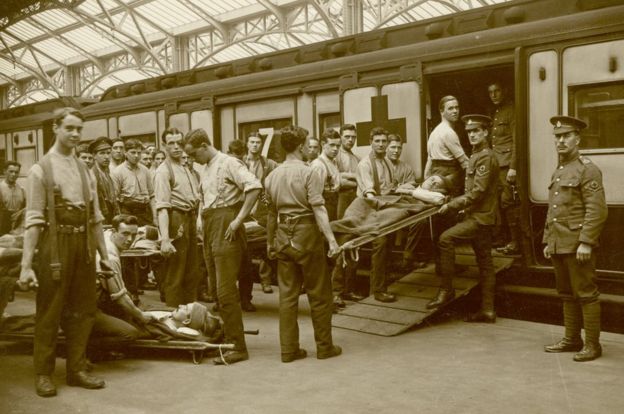 WILLIS FAMILY COLLECTION
 NRM
NRM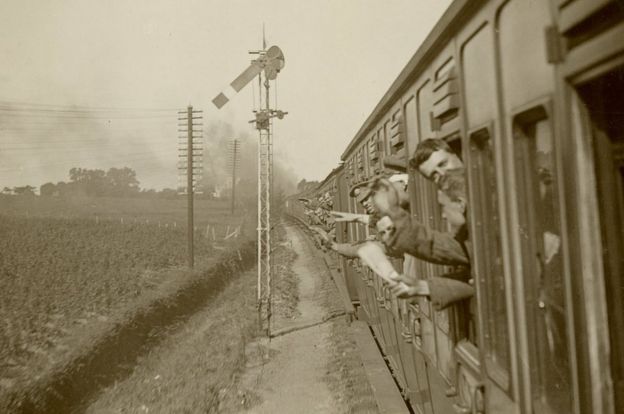 NRM
NRM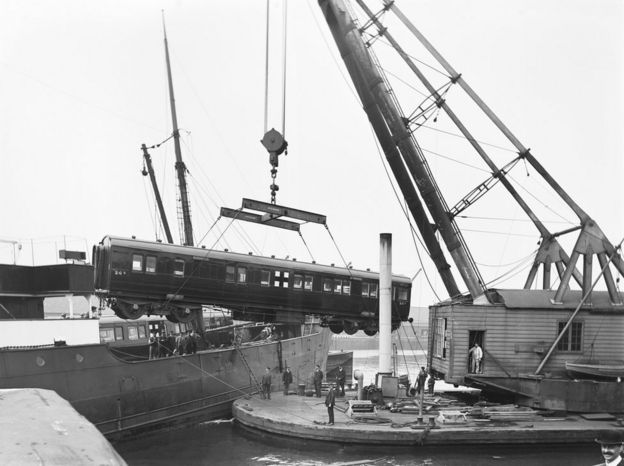 NRM
NRM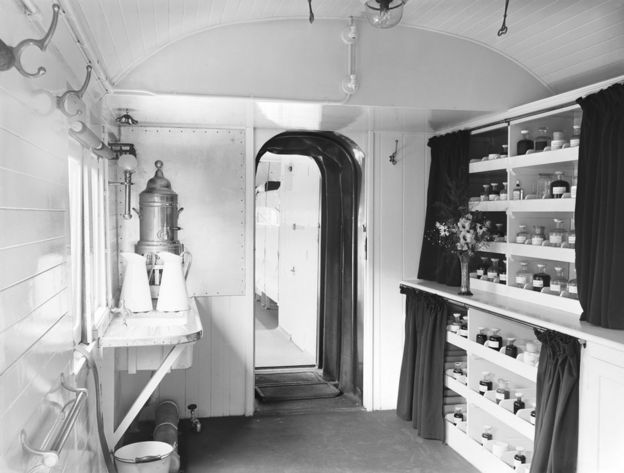 HORWICH WORKS


